Tampilkan postingan dengan label antique mirror. Tampilkan semua postingan

Senin, 22 September 2014

duplicate special mirror


duplicate special mirror, amazing mirror, antique mirror

duplicate special mirror __ The mirror features a complex and intriguing history that spans centuries and countries around the globe. The appeal of the mirror has always been clear- it allows the user to see and understand their very own image with every line and blemish on the face reflected, nothing hidden. The capability mirrors must reflect light so perfectly remains unrivalled by some other object. With no reflection inside the mirror, no-one would be proud of their appearance. For this reason capability to reflect light and show appearance so precisely and incredibly, mirrors were widely believed to have magical powers.

A well-known superstition about mirrors is when you smash one, you will have 7 years misfortune. This superstition is believed to have originated from ancient times, when mirrors were thought to be tools of the gods. Mirrors are already coveted since ancient times, since man first saw his reflection inside a pond or lake. In highly cultured aspects of the planet for example Rome and Egypt, they used more crude forms to see a reflection of their image, by making mirrors from materials such as bronze and metal. This was well before the greater advanced and practical glass-making of mirrors.

Glass-making revolutionised how mirrors would work. Before this, the phrase "mirror" represented any material that had been fashioned in a fashion that allowed the consumer to determine their reflection. In present day, when one hears the word "mirror" they associate it with a sheet of glass used as either an object of decoration or as a household object. Mirrors are actually extremely commonplace objects, and you would be hard pushed to locate a home with out them. Mirrors weren't always so common, however. This short article looks at the lengthy history of the mirror, and focuses particularly about the Venetian glassmakers that revolutionised the mirror world by the advance of the Venetian glass mirror.
The history with the glassmaking of mirrors began in 1255 when artisans, the creators of pearls, flasks and glass, settled in Murano, Italy, the birthplace from the now famous Venetian mirror. The draw of Murano was these artisans could protect the tricks of their trades from curious eyes.

Venetian glassmakers hurried to become listed on these phones be within the protection. These glassmakers in Murano produced the world-renowned Venetian glass, that later began producing Venetian mirrors. In the 15th century, glass from Murano was known throughout Europe because of the good quality glassware, beauty and magnificence. Murano glassmakers knew how to make crystalline glass and in addition discovered a completely unique solution to producing large items of glass with unblemished surfaces and highly reflected surfaces, which set them besides other types of glass and glass makers. The beauty of the glass manufactured in Venice was attributed to 3 main things. The initial was the composition with the salt and soda in the Italian silica it absolutely was produced from. The second was the sort of flame used in the firing process and also the third was the salinity from the ocean water used. The many attributes that made Venetian glass so beautiful insured that by the early 1500's, the Venetian glassmaking industry had expanded and virtually destroyed all competition from all around the world. The production of mirrors from Venice began with Venetian glassmaking.

Mirrors came back into fashion at the outset of the 15th century, at a time where mirror and glass making was rapidly evolving in Venice. The Venetian glassmakers were already famed for his or her elegant and delightful design of glass production, therefore at the outset of the 16th century, Venice became a centre of mirror production. Venetian mirror makers used their world-renowned and gorgeous glass to produce authentic Venetian mirrors. These mirrors were considered the purest mirrors on earth, unrivalled by any other material of maker. Through the 16th century (plus a number of centuries after), real Venetian mirrors were very difficult to come across. Small steel mirrors became a day to day object simply because they were available everywhere and were cheap to buy. When it comes to excellence of the mirror though, real Venetian glassmirrors were utterly unrivalled through the unattractive, non extravagant and small steel mirrors. Venetian mirrors were coveted after. These were exported not only all over Europe, but also to the East. Two famous palaces, the Isfahan palace as well as the Lahore palace purchased Venetian mirrors that they proudly hung in their decorative and extravagant palaces.

Çontact Us
Address : Jln. Bonang 3 RT 2 RW 2, Joyotakan, Serengan, Surakarta, Jawa Tengah, Indonesia, Indonesia 57157Owner : Prima Warsa BaruPhone :  +62 888 6 827 827Email : sales@jagomerahcraft.comFanpage Facebook : jagomerahcraft

Rabu, 03 September 2014

spectacular glass


spectacular glass, amazing mirror, antique mirror

spectacular glass __ Murano Redux. Murano is a small group of islands lying on the edge of the Adriatic Sea in the lagoon of Venice, about 3,000 meters north of the larger group of islands comprising the city of Venice.

In the 100 years between 1860 and 1960 the glass producing firms located on Murano rose to world leadership in the production of decorative glass objects. One of the most remarkable aspects of this remarkable achievement is that it was the second time that Murano had attained that pinnacle--and the two occasions were separated by 500 years.

Early triumph. Glassmaking existed in the lagoon of Venice from as early as the 8th century. In ensuing centuries the artisans of Venice began to accumulate some singular skills in glass production--gathered presumably in the course of the Republic of Venice's extensive trade throughout the Eastern Mediterranean and in the Islamic territories of the Levant and North Africa. In this connection, the conquest of Constantinople in 1204 by the wayward Fourth Crusade was a watershed event, opening to Venice the practices of the glass producers of that great imperial city.

By 1291 the glassmakers of the Venetian lagoon had distilled all of that knowledge into unique and proprietary production skills. In that year the government of Venice banned glass furnaces from the central islands of Venice, relegating them to Murano. Most historians have assumed that the order resulted from a fear that the fires of the glass furnaces might create a tragic conflagration among the largely wooden structures of crowded Venice. However, it has been plausibly suggested that the move was made in order to isolate the master glassblowers and prevent their sharing their valuable glassmaking knowhow with foreigners. In fact, the glassblowers became virtual prisoners on Murano, insulated from any contacts who might divulge their production secrets to potential competitors abroad. Venetian--or Murano--glassmaking became the leading source for fine glass in Europe and a major source of trading income for the Republic of Venice.

Most of the glass of that period, though luxurious, was utilitarian. Mirrors, for example, were major revenue producers, but beautiful and intricate decorative objects were produced as well, often exhibiting complex new techniques developed by Murano's extraordinary artisans.

Slow secular decline. Yet trade domination built on monopoly--especially a monopoly in knowhow--is inherently unstable. By the 1600s important rival centers had begun to emerge, notably in France and Moravia. At the same time, shifting trade routes began to undermine Venice's strategic trading advantages. As a result, the decline in Venice's general political and commercial importance after 1600 was mirrored by the gradual, long-term decline of its glass industry on Murano. Final collapse for both the republic and the industry came with the conquest of Venice by Napoleone's French forces in 1797, followed in 1814 by the ultimate transfer of Venice from France to the Habsburg Empire centered in Austria.

Death by regulation. Austrian sovereignty brought swift regulatory strangulation to Murano, as the Habsburg government overtly favored the other glassmaking center within its Empire, Bohemia. The import into Murano of the requisite raw materials was severely restricted or punitively taxed. As a result, the number of active glass furnaces on Murano plunged from 24 in 1800 to 13 just 20 years later. Even more telling, only five of those 13 factories produced blown glass; at the others, production was reduced primarily to decorative beads and other small items that the Empire needed for trade abroad.

A gloomy realist might have predicted that the last furnace fire on Murano would soon be extinguished. Such a prediction, however, would have overlooked the fierce, centuries-old creative heritage of the traditional glassblowing families of Murano. They kept alive--or periodically rediscovered--the remarkable old techniques that had reached full flower in the 1400s, even though the new economic and political realities had virtually eliminated all demand for the elaborate and costly products that those skills could create.

New life. Like twin robins of spring, two events of the 1850s herealded a new and better period ahead. The earlier in time was the founding in 1854 of a promising new glass furnace on Murano by six enterprising sons of Pietro Toso. Their new firm,Fratelli Toso, concentrated initially on producing utilitarian glass, but they soon showed that they had grander ambitions and skills.

The second notable event came in 1859 when an industrious lawyer from Vicenza, Antonio Salviati, arrived on Murano with a vision of a new market niche. His new firm Salviati dott. Antonio fu Bartolomeo focused on producing glass tiles for repairing the ubiquitous old mosaics of Venice and creating new ones. Fortuitously, the master glassblowers that he assembled for the new business included Lorenzo Radi, who had devoted considerable efforts in the 1850s to resurrecting some of the sophisticated glassmaking techniques from Murano's first heyday in the 1400s.

Salviati's mosaic glass production met with the success that he had anticipated, but his greatest innovation lay in the insights that he brought for marketing Murano glassware through new distribution channels. His first success came in England in 1862 when the firm captured international attention with its prize-winning display at a world exhibition in London. Salviati boldly used the occasion to present products in chalcedony glass, a medium that Radi had revived in 1856. Salviati followed up on that first success by opening a London sales office in 1868.

At last the Murano glassblowers had found the salesman they needed for exploiting their skills throughout the broad markets beyond Italy and the Habsburg Empire. The political winds were shifting as well, as the Veneto was wrested free of the Austrians in 1866 to become part of the expanded Kingdom of Italy. The new sovereign brought his own difficult taxes, but the business climate improved and the glass producers of Murano began to flourish again, led first by Salviati and Fratelli Toso, and soon by other innovative firms such as Fratelli Barovier and Francesco Ferro & Figlio.

Modern leadership. For the most part, the designs of the new and revitalized firms relied heavily upon their traditional Murano skills at creating intricate curlicue fantasies in glass, though influenced by the art nouveau movement near the end of the century. Designs were usually the invention of the glassblowers themselves. Many of their works were exhuberant masterpieces, but the glassblowers were ultimately constrained by the fact that they worked within an artisan tradition, not an artistic one.

New forces were at work, however, beginning to open Murano to changes stirring in the international art world. The first Venice Biennale was staged in 1895, bringing to Venice avant garde and innovative art from throughout Europe and challenging Murano glassmakers to stretch as well. Artists of Venice and Murano assembled in informal groups to exchange and espouse new artistic ideas. One such group, associated with Cà Pesaro and the Bevilacqua La Masa Foundation, included a number of artists who would bring new design ideas to the Murano glassmakers. Prominent among them Vittorio Zecchin, Napoleone Martinuzzi and, briefly but most importantly, Hans Stoltenberg-Lerche and Teodoro Wolf-Ferrari.

In 1921 there arrived the final element needed to propel Murano once again into world leadership in its field. From Milan came Giacomo Cappellin and Paolo Venini to found their own new glassworks, Vetri Soffiati Muranesi Cappellin, Venini & C., with a particular focus on modern design. Many of their key early designers were actually themselves from Murano, but they were selected and supervised by the new owners with a distinct sensitivity to the new design trends that were sweeping the world and were so fiercely felt and debated at Milan. Venini was a native of the Milan area; Cappellin, though a Venetian by birth, owned and operated an antique shop on Milan's via Montenapoleone. The new creative spark ignited by Cappellin and Venini quickly swept Murano. The competitive spirit of the glassmakers soon catapulted numerous Murano producers to the cutting edge of artistic design and artisan skill that continues to characterize Murano glass down to the present day.

Çontact Us

Address : Jln. Bonang 3 RT 2 RW 2, Joyotakan, Serengan, Surakarta, Jawa Tengah, Indonesia, Indonesia 57157Owner : Prima Warsa BaruPhone :  +62 888 6 827 827Email : sales@jagomerahcraft.comFanpage Facebook : jagomerahcraft

Sabtu, 30 Agustus 2014

glass is awesome


glass is awesome, antique mirror, beautiful mirror

glass is awesome __ Venetian mirrors are the extraordinary elements that anyone who can afford to buy them can add in their rooms in order to enhance the elegance of their home. These mirrors are for sure would give more than hundred percent of the value for what you have bought them for. Also you can very happily enjoy the home environment created after furnishing your home with these mirrors. No other element can be compared with the beauty and the awesome ness that these mirrors posses and give out to you when used. These mirrors are incomparable. Offcourse these mirrors need the buyer to spend a penny or a two extra but still one can say that these are worth for what they are.

These mirrors are in most cases affordable by the upper class as the price range would be from thousand dollars to hundred thousand dollars. This would be the case for the original or the antique pieces that we get. But there are other type of Venetian mirrors that are available as the derivatives of Venetian mirrors. This doesn’t mean that they are the duplicate ones. These mirrors too are hand crafted by well trained artisans but of less cost. These kinds of mirrors are affordable by even a common man too. Really the one who owns these mirrors can only experience the real beauty of these mirrors. These gorgeous mirrors’s beauty cannot be defined or stated in words.

The Venetian mirrors have a history dated back since sixteenth century.The original pieces or the antique pieces are handcrafted in the home town of the Venetian mirrors that is in Italy. This is a place where you can find skilful artisans with ultimate talent in carving out mind blowing designs of Venetian mirrors. The mirror is mad to undergo various processes like etching wherein the glass is treated with acidic solutions in order to bring out the designs, designing the details in the mirror with hand by studding the mirror with precious stones and gems and gilding them and all such are done in order to bring out the beautiful, gorgeous and awesome Venetian mirror. Though you can get a derivative of Venetian mirror that can be obtained at any place on the earth but the look and feel of the antique Venetian mirror can never be reached. 

The Venetian mirrors are carried out from one generation to the next as a pride and hence it would always be better to have the original form of it. In the antique piece you can get artwork done by skilled gaffers belonging to Italy and hence you can be very sure of the beady. These are available in the market and also you can have them online. There are numerous online resources that would give you the information and display the models related to the antique pieces of Venetian mirrors. Just bring these awesome pieces to your home and enjoy the beauty of these mirrors along with the pride to possess the Venetian mirrors.  

Çontact Us
Address : Jln. Bonang 3 RT 2 RW 2, Joyotakan, Serengan, Surakarta, Jawa Tengah, Indonesia, Indonesia 57157Owner : Prima Warsa BaruPhone :  +62 888 6 827 827Email : sales@jagomerahcraft.comFanpage Facebook : jagomerahcraft

Kamis, 28 Agustus 2014

Unique glass


Unique glass, antique mirror, beautiful mirror

Unique glass __ Other types of reflecting device are also called "mirrors".

• Acoustic mirrors are passive devices used to reflect and perhaps to focus sound waves. Acoustic mirrors were used for selective detection of sound waves, especially during World War II. They were used for detection of enemy aircraft prior to the development ofradar. Acoustic mirrors are used for remote probing of the atmosphere; they can be used to form a narrow diffraction-limited beam.They can also be used for underwater imaging.

• Active mirrors are mirrors that amplify the light they reflect. They are used to make disk lasers. The amplification is typically over a narrow range of wavelengths, and requires an external source of power.

• Atomic mirrors are devices which reflect matter waves. Usually, atomic mirrors work at grazing incidence. Such mirrors can be used for atomic interferometry and atomic holography. It has been proposed that they can be used for non-destructive imaging systems withnanometer resolution.

• Cold mirrors are dielectric mirrors that reflect the entire visible light spectrum, while efficiently transmitting infrared wavelengths. These are the converse of hot mirrors.

• Corner reflectors use three flat mirrors to reflect light back towards its source, they may also be implemented with prisms that reflect using total internal reflection that have no mirror surfaces. They are used for emergency location, and even laser ranging to the Moon.

• Hot mirrors reflect infrared light while allowing visible light to pass. These can be used to separate useful light from unneeded infrared to reduce heating of components in an optical device. They can also be used as dichroic beamsplitters. (Hot mirrors are the converse of cold mirrors.)

• Metallic reflectors are used to reflect infrared light (such as in space heaters or microwaves).

• Non-reversing mirrors are mirrors that provide a non-reversed image of their subjects.

• X-ray mirrors produce specular reflection of X-rays. All known types work only at angles near grazing incidence, and only a small fraction of the rays are reflected. See also X-ray optics.

Çontact Us

Address : Jln. Bonang 3 RT 2 RW 2, Joyotakan, Serengan, Surakarta, Jawa Tengah, Indonesia, Indonesia 57157Owner : Prima Warsa BaruPhone :  +62 888 6 827 827Email : sales@jagomerahcraft.comFanpage Facebook : jagomerahcraft

elegant glass


elegant glass, antique mirror, beautiful mirror

elegant glass __ Venetian mirrors were very popular since the 16th century. These mirrors were available to royal families only. As they were very expensive, they are not popular among common households. In the recent past, all kinds of people are able to use venetian mirrors as they are affordable and available in plenty of designs. They are being adorned because of their decorative nature. You will be able to use venetian mirror as a standalone décor piece as well. It can serve the decorative purpose without taking help of any accents or accessories.

Enhanced beauty
A venetian mirror comes with long lines and sweeping arches. The borders and edges are enhanced so that the mirror delivers flawless perfection. You can find venetian mirrors in different designs, shapes and sizes. The mirror will come with stylish edges and they will have ornamental value. A venetian mirror can be installed at any location in your home. It will fit into the bedroom, living room and bathroom.

You should remember the important fact about wall mirrors. They will create an illusion that you are living in a large space, even though the size of the room is very small. Hence, it is very much important to figure out the right location to install the mirror. Venetian mirrors come with magnificent rosettes, etched carvings and mirrored borders. Because of their beauty enhancing proportion, a venetian mirror will always be one of the weapons of an interior decorator. If you would like to go to a standalone mirror that propels the timeless art, venetian mirror is the best choice.

Collector’s choice
For collectors, venetian mirror is a great choice and an investment. The gorgeous decorative piece will bring remarkable change at any location of our home. The mirror is a functional aid as well as an artistic mastery. In addition to the intricate glass work, you can take advantage of the reflective nature of the mirror as well.
By installing one or more of Venetian mirrors at home, you can bring a touch of class and elegance to your home decoration. It is a great way to reflect your taste and style. In most of the homes, these mirrors are used as focal points. In order to prepare a venetian glass, sheets of blown glass will be used. The mirror will be decorated with blown glasses. In order to create great masterpieces of art, the pieces will be etched.
By using the etched glasses, different kinds of adornments and shapes are produced. Thus, the resulting mirror will be a stunning piece.

Unique mirrors are produced by beveling, polishing, cutting and etching them. Some simple mirrors will be made marvelous masterpieces by adding attachments and coloring of beveled edges. When you go for glass blowing, individual blown glasses will be attached together and versatile mirror will be prepared. Blown pieces of rosettes, flowers, trumpets and other creative designs will be attached to produce mind blowing master pieces. Even though original venetian mirrors are available in Venice, you can procure them through online as well.

Çontact Us
Address : Jln. Bonang 3 RT 2 RW 2, Joyotakan, Serengan, Surakarta, Jawa Tengah, Indonesia, Indonesia 57157Owner : Prima Warsa BaruPhone :  +62 888 6 827 827Email : sales@jagomerahcraft.comFanpage Facebook : jagomerahcraft

graceful mirror


graceful mirror, antique mirror, beautiful mirror

graceful mirror __ The 18th century saw the seeds of decay start to grow in Murano. Worker unrest at the closure of furnaces saw unemployment increase. As we have seen the decline in the importance of Venice as a trading and political power also meant it was less able to police its restrictive rules designed to protect its glass industry. Occupation by the French under Napoleon Bonaparte in 1797 and then the subsequent transfer of Venice to the Hapsburg Empire in 1814 brought the Venetian Republic to an end.
Glass production in Murano suffered enormously under Austrian rule as regulations were introduced which overtly favoured the other major glass making in the Empire, namely Bohemia. This saw Bohemian crystal, thicker, heavier and often engraved, grow in popularity to the point of rivalling Murano glass’ popularity the century before. Taxation of raw materials, limited markets, and the abolishment of the Guild in 1805 saw a sharp decline in the number of furnaces – down to 24 in 1800 which further shrank to 13 by 1820. Master glass makers were now scattered across Europe and the remaining Murano producers chose to focus on the decorative beads, small bottles, and trinkets needed for overseas colonial trade.
This decline did not bottom out until the mid 19th century with the establishment of a new family glass furnace on Murano, called Fratelli Tosco in 1854. This was followed by the arrival on the island of an industrial lawyer by the name of Antonio Salviati in 1859 who set up another furnace. Fratelli initially focused on utilitarian everyday glassware, whilst Salviati focused on producing glass tiles for both the repair of Venetian mosaics and the creation of new ones. The master glassblowers who gravitated towards these two firms were among the many who had kept the glassblowing traditions alive, maintaining the art of their fathers and grandfathers, rediscovering the ancient glass making techniques, including Lorenzo Radi, who had devoted considerable efforts in the 1850s to resurrecting some of the sophisticated glassmaking techniques from Murano’s first heyday in the 1400s. This steady reversal in fortunes was further aided by Vincenzo Zanetti who developed the Glass Museum of Murano, which in reality was more of a school which alongside the new furnaces slowly began reintroducing lost glass blowing techniques.
The output from the Salviati factory gained international recognition at both the London World Exhibition in 1862 and the Universal Exposition in Paris in 1867, in large part due to Antonio’s marketing abilities. At the London event his firm captured international attention with its prize-winning display with Salviati boldly using the occasion to present products in chalcedony glass, a medium that Radi had revived in 1856.
This recognition of artistic merit was paralleled by commercial success, and the firm soon inaugurated a sales office in London in 1868. These initiatives opened new markets for Venetian glass beyond those in the Hapsburg Empire. Eventually, Venice was freed from the Austrians in 1866 and became part of the Kingdom of Italy, and gradually the glassmaking industry of Murano began to expand commercially and many new innovative firms were established such as Fratelli Barovier and Francesco Ferro & Figlio.
Beyond drawing on the centuries old traditions of glass making in Murano, including the rediscovery of murrine, a glass making technique from Roman times, new influences were needed to re-inspire the industry. The Murano glass workers were constrained by the fact that they had always worked within an artisan tradition rather than an artistic one. This inspiration needed began with the art nouveau movement at the end of the centre, but was further fuelled and redirected by the avant garde reaction to this movement within the European art world. These new ideas and innovations from across Europe were evident for all to see at the 1895 Venice Biennale.
Çontact Us
Address : Jln. Bonang 3 RT 2 RW 2, Joyotakan, Serengan, Surakarta, Jawa Tengah, Indonesia, Indonesia 57157Owner : Prima Warsa BaruPhone :  +62 888 6 827 827Email : sales@jagomerahcraft.comFanpage Facebook : jagomerahcraft

Rabu, 27 Agustus 2014

decorative mirror


decorative mirror, antique mirror, beautiful mirror

decorative mirror __ A simple way to incorporate an elegant look into any room is the addition of an exquisite Venetian mirror. These treasured pieces reflect light and serve as an artistic focal point, transforming a room into a glamorous environment with a bit of old-world elegance.
Mirrors are helpful for checking your outfit one last time before you run out the door. But did you know that adding decorative mirrors to your home's decor is a great way to increase the amount of interior light? Or that mirrors can easily serve as an artistic element, as well? A mirror is much more than just a simple reflective surface, and the right mirror can make all the difference in the world.
The most elegant and prestigiousmirrors are made in Murano, Italy. Skilled craftsmen carefully create these works of art by hand, using techniques and secrets that have been passed down from one to another over many centuries of working with glass. Many Venetian mirrors that were hand-crafted centuries ago are still in existence, treasured by families who have enjoyed them from generation to generation.
Today's skilled Venetian glass craftsmen still use the time-proven artistic techniques to create elegant Venetian mirrors. From simple etched glass styles to more elaborate beveled or beaded designs, and with a wide variety of shapes and sizes, there's a Venetian glass mirrors for every 
decorating
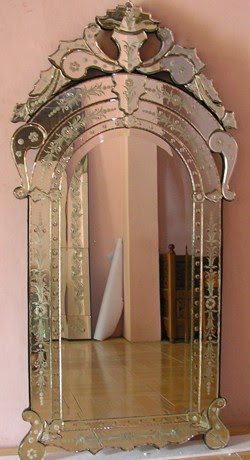
 situation. While many Venetianmirrors are produced in a classic oval shape, you'll also find rectangular shapes, octagons, and even mirrors with elaborate crested designs at their tops. In addition to beveled and etched patterns, you'll frequently see gold highlights, floral and leaf designs, and even sweet rosettes on these artistic treasures.

A classic look for a formal living or dining room involves positioning a statement mirror on a prominent wall. In a dining room, a beautiful Venetian glass mirror can reflect the soft light from the chandelier and enhance the ambiance of a meal with family and friends. In a living room, the intricate hand-crafted beauty of a Venetian glass mirror is right at home serving as a decorative artistic treasure.

But don't think that a statement mirror must be confined to the formal rooms within your home. In a hallway, a Venetian mirror opens up a dark area and provides interest and excitement. A Venetian mirror in the bedroom provides subtle elegance and style, and even a bathroom can be beautifully glammed up with the addition of one of these Venetian glass masterpieces

Çontact Us
Address : Jln. Bonang 3 RT 2 RW 2, Joyotakan, Serengan, Surakarta, Jawa Tengah, Indonesia, Indonesia 57157Owner : Prima Warsa BaruPhone :  +62 888 6 827 827Email : sales@jagomerahcraft.comFanpage Facebook : jagomerahcraft

special mirror


special mirror, antique mirror, beautiful mirror

Venitian glass is a type of collectible glass that is also known by many as Murano glass. It received this name because it was primarily made on the island of Murano in Venice, Italy, during the mid-thirteenth century. Venetian glass is considered an art form and it is much desired and sought by both art and glass collectors. The advent of the Internet has made it possible for people to collect Venetian glass without ever having to leave home.

History
• Many glassworkers fled to Venice during the Fourth Crusade when Constantinople was attacked. This happened again in 1453 when Constantinople was taken by the Ottomans. These Venetian artists mastered control over the transparency and color of glass, as well as decorating techniques, by the 16th century and Murano became the reputed center of glassmaking. Glassmaking artisans eventually became the prominent citizens of Murano. Their great glass artistry gained them immunity from prosecution, the availability of prospective brides from Venice, and the permission to wear swords.
Process
• Making Venetian glass was a complex process. The glass was made out of silica. The silica turned to liquid when it was exposed to extreme temperatures. As the glass went from a liquid state to a solid state, there was a period of time when the glass completely hardened. It is during this time when the artisans shaped the material. Other materials used to make the glass included nitrate, arsenic and coloring.

Techniques and Colors
• Depending on what the artisan wanted to produce, the materials, techniques and colors that were used varied. For instance, an aquamarine glass was created using copper and cobalt compounds added to the mix, and an artist wanting to produce a red piece of glass would use a gold solution. Techniques that were employed in Venetian glass making included gold engraving, enamel painting, engraving, ribbed glass and more.
Tools
• Venetian glass artists used tools that were specialized specifically for glass work and art. These tools included pliers and tongs that were used to hand-form the hot glass, an iron rod that where the glass was attached so the artisan could add the finishing touches, cutting clippers and the work bench.
Benefits
• Owning a piece of Venetian glass is considered more than just glass collecting, it's a form of art and history collecting. Venetian glass is all about the history of the glass, as it was truly the first type of clear glass that was ever produced.

Çontact Us
Address : Jln. Bonang 3 RT 2 RW 2, Joyotakan, Serengan, Surakarta, Jawa Tengah, Indonesia, Indonesia 57157Owner : Prima Warsa BaruPhone :  +62 888 6 827 827Email : sales@jagomerahcraft.comFanpage Facebook : jagomerahcraft
Selasa, 26 Agustus 2014

handicraft


handicraft, antique mirror, beautiful mirror

handicraft __ A mirror is an object that has at least one of its surfaces being reflective in nature. The first ‘mirrors’ were created using obsidian, a type of volcanic glass, in 6000BC. It is only during the early renaissance period that mirrors as we know them started being made in Europe, whereby glass was coated using a combination of tin and mercury. From then onwards, better quality mirrors have been made in many different styles.

Venetian mirrors are highly regarded works of art that were first produced in early 16th century Venice; they are currently produced on the island of Murano. The origins of the Venetian mirror date back to the Renaissance when Venice already excelled in the production of mirrors and other skills in glassmaking.These mirrors are crafted in fourteen separate stages including faceting of the glass, the engraving of various designs like fruiting vines and scroll motifs, and a traditional silvering process.

Venetian mirrors are widely regarded as being the most stylish and elegant.Venetian mirrors have the power to enhance the space in an elegant style. This piece of art works like a jewelry for homes. Being the pioneers, Jago Merah Craft produces extremely high quality Venetian mirrors. Popularly known for handcrafted mirrors, brilliance of colours and their precision of engraving, grinding and finishing.

Venetian mirrors are available in various designs and dimensions. A range of furniture and artefacts are also available in Venetian mirrors. With constant efforts, brilliant idea and with the help of technology, Jago Merah Craft glassmakers have come to design and produce the ‘future of Venetian Mirrors’

Çontact Us
Address : Jln. Bonang 3 RT 2 RW 2, Joyotakan, Serengan, Surakarta, Jawa Tengah, Indonesia, Indonesia 57157Owner : Prima Warsa BaruPhone :  +62 888 6 827 827Email : sales@jagomerahcraft.comFanpage Facebook : jagomerahcraft

antique mirror


antique mirror, beautiful mirror, special mirror

antique mirror __ The first mirrors used by people were most likely pools of dark, still water, or water collected in a primitive vessel of some sort. The earliest manufactured mirrors were pieces of polished stone such as obsidian, a naturally occurring volcanic glass. Examples of obsidian mirrors found in Anatolia (modern-day Turkey) have been dated to around 6000 BC. Polished stone mirrors from Central and South America date from around 2000 BC onwards Mirrors of polished copper were crafted in Mesopotamia from 4000 BC, and in ancient Egypt from around 3000 BC. In China, bronze mirrors were manufactured from around 2000 BC, some of the earliest bronze and copper examples being produced by the Qijia culture. Mirrors made of other metal mixtures (alloys) such as copper and tin speculum metal may have also been produced in China and India. Mirrors of speculum metal or any precious metal were hard to produce and were only owned by the wealthy.

Metal-coated glass mirrors are said to have been invented in Sidon (modern-day Lebanon) in the first century AD, and glass mirrors backed with gold leaf are mentioned by the Roman author Pliny in his Natural History, written in about 77 AD. The Romans also developed a technique for creating crude mirrors by coating blown glass with molten lead.

Parabolic mirrors were described and studied in classical antiquity by the mathematician Diocles in his work On Burning Mirrors. Ptolemyconducted a number of experiments with curved polished iron mirrors, and discussed plane, convex spherical, and concave spherical mirrors in his Optics. Parabolic mirrors were also described by the physicist Ibn Sahl in the 10th century, and Ibn al-Haythamdiscussed concave and convex mirrors in both cylindrical and spherical geometries, carried out a number of experiments with mirrors, and solved the problem of finding the point on a convex mirror at which a ray coming from one point is reflected to another point. By the 11th century, clear glass mirrors were being produced in Moorish Spain.

In China, people began making mirrors with the use of silver-mercury amalgams as early as 500 AD.Some time during the earlyRenaissance, European manufacturers perfected a superior method of coating glass with a tin-mercury amalgam. The exact date and location of the discovery is unknown, but in the 16th century, Venice, a city famed for its glass-making expertise, became a centre of mirror production using this new technique. Glass mirrors from this period were extremely expensive luxuries. The Saint-Gobain factory, founded by royal initiative in France, was an important manufacturer, and Bohemian and German glass, often rather cheaper, was also important.

The invention of the silvered-glass mirror is credited to German chemist Justus von Liebig in 1835. His process involved the deposition of a thin layer of metallic silver onto glass through the chemical reduction of silver nitrate. This silvering process was adapted for mass manufacturing and led to the greater availability of affordable mirrors. Nowadays, mirrors are often produced by the wet deposition of silver (or sometimes aluminum via vacuum deposition) directly onto the glass substrate.

Çontact Us

Address : Jln. Bonang 3 RT 2 RW 2, Joyotakan, Serengan, Surakarta, Jawa Tengah, Indonesia, Indonesia 57157Owner : Prima Warsa BaruPhone :  +62 888 6 827 827Email : sales@jagomerahcraft.comFanpage Facebook : jagomerahcraft