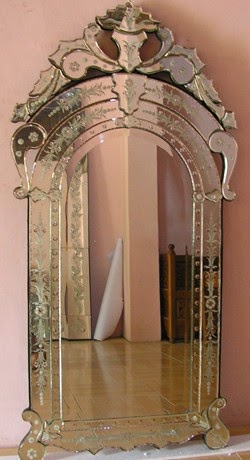
graceful mirror __ The 18th century saw the seeds of decay start to grow in Murano. Worker unrest at the closure of furnaces saw unemployment increase. As we have seen the decline in the importance of Venice as a trading and political power also meant it was less able to police its restrictive rules designed to protect its glass industry. Occupation by the French under Napoleon Bonaparte in 1797 and then the subsequent transfer of Venice to the Hapsburg Empire in 1814 brought the Venetian Republic to an end.
Glass production in Murano suffered enormously under Austrian rule as regulations were introduced which overtly favoured the other major glass making in the Empire, namely Bohemia. This saw Bohemian crystal, thicker, heavier and often engraved, grow in popularity to the point of rivalling Murano glass’ popularity the century before. Taxation of raw materials, limited markets, and the abolishment of the Guild in 1805 saw a sharp decline in the number of furnaces – down to 24 in 1800 which further shrank to 13 by 1820. Master glass makers were now scattered across Europe and the remaining Murano producers chose to focus on the decorative beads, small bottles, and trinkets needed for overseas colonial trade.
This decline did not bottom out until the mid 19th century with the establishment of a new family glass furnace on Murano, called Fratelli Tosco in 1854. This was followed by the arrival on the island of an industrial lawyer by the name of Antonio Salviati in 1859 who set up another furnace. Fratelli initially focused on utilitarian everyday glassware, whilst Salviati focused on producing glass tiles for both the repair of Venetian mosaics and the creation of new ones. The master glassblowers who gravitated towards these two firms were among the many who had kept the glassblowing traditions alive, maintaining the art of their fathers and grandfathers, rediscovering the ancient glass making techniques, including Lorenzo Radi, who had devoted considerable efforts in the 1850s to resurrecting some of the sophisticated glassmaking techniques from Murano’s first heyday in the 1400s. This steady reversal in fortunes was further aided by Vincenzo Zanetti who developed the Glass Museum of Murano, which in reality was more of a school which alongside the new furnaces slowly began reintroducing lost glass blowing techniques.
The output from the Salviati factory gained international recognition at both the London World Exhibition in 1862 and the Universal Exposition in Paris in 1867, in large part due to Antonio’s marketing abilities. At the London event his firm captured international attention with its prize-winning display with Salviati boldly using the occasion to present products in chalcedony glass, a medium that Radi had revived in 1856.
This recognition of artistic merit was paralleled by commercial success, and the firm soon inaugurated a sales office in London in 1868. These initiatives opened new markets for Venetian glass beyond those in the Hapsburg Empire. Eventually, Venice was freed from the Austrians in 1866 and became part of the Kingdom of Italy, and gradually the glassmaking industry of Murano began to expand commercially and many new innovative firms were established such as Fratelli Barovier and Francesco Ferro & Figlio.
Beyond drawing on the centuries old traditions of glass making in Murano, including the rediscovery of murrine, a glass making technique from Roman times, new influences were needed to re-inspire the industry. The Murano glass workers were constrained by the fact that they had always worked within an artisan tradition rather than an artistic one. This inspiration needed began with the art nouveau movement at the end of the centre, but was further fuelled and redirected by the avant garde reaction to this movement within the European art world. These new ideas and innovations from across Europe were evident for all to see at the 1895 Venice Biennale.
Çontact
Us
Address :
Jln. Bonang 3 RT 2 RW 2, Joyotakan, Serengan, Surakarta, Jawa Tengah,
Indonesia, Indonesia 57157Owner : Prima Warsa BaruPhone : +62
888 6 827 827Email : sales@jagomerahcraft.comFanpage Facebook :
jagomerahcraft