Tampilkan postingan dengan label special mirror. Tampilkan semua postingan

Rabu, 27 Agustus 2014

interior mirror

interior mirror, special mirror, decorative mirror
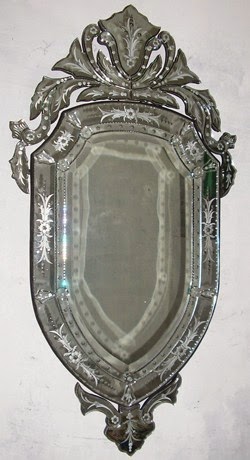
History Of The Enchanting Venetian Mirror
interior mirror __ Humans, it seems, have always been interested in their image, making crude mirrors of polished tin and other metals. Eventually, in Europe, glass was poured over polished metal to yield better forms of reflectors. During the medieval period, mirrors were considered a tool of the devil, as it was widely thought that Satan was watching from the other side. Glass mirrors disappeared, leaving people to check their appearance in bowls of water or a polished spoon.

As mirrors came back into fashion in the early 15th century, glassmaking and mirror making was burgeoning in Venice, Italy. Nestled among 117 sister islands in the canals of Venice, lies Murano, the birthplace of the famed Venetian Mirror. Murano, in the 15th century was known throughout Europe, for its high quality glassware, Venetian elegance, and beauty. Apart from the detailed craftsmanship of the artisans, the beauty of Venetian glass was attributed to the salt content of the ocean water used, the composition of the Italian silica, and the type of flame used for firing. It is said that the local hardwoods produced the perfect flame for producing exquisite glass pieces. Venetian glass makers fiercely guarded their techniques, but eventually crafty artists from France and Germany infiltrated the artist’s society, returning home to practice their new skills. Still, Venetian glass and mirrors remained a coveted and valuable entity, and one of the most costly items one could own, a true status symbol.


Today, over 500 years later, Venetian mirrors are just as beautiful and stylish, adding a tough of elegance to any home. Venetian mirrors reflect light, and project a lovely Venetian atmosphere. When combined with Venetian furniture, jewel toned drapes and tapestries, and plastered walls, a well-placed Venetian mirror can transform one’s home into a Venetian Renaissance villa. Venetian mirrors can be found in a multitude of styles, from art deco in appearance to those appearing to have been plucked straight from a wealthy Medici Venetian style home in 15th century Italy.

Çontact Us

Address : Jln. Bonang 3 RT 2 RW 2, Joyotakan, Serengan, Surakarta, Jawa Tengah, Indonesia, Indonesia 57157Owner : Prima Warsa BaruPhone :  +62 888 6 827 827Email : sales@jagomerahcraft.comFanpage Facebook : jagomerahcraft

special mirror


special mirror, antique mirror, beautiful mirror

Venitian glass is a type of collectible glass that is also known by many as Murano glass. It received this name because it was primarily made on the island of Murano in Venice, Italy, during the mid-thirteenth century. Venetian glass is considered an art form and it is much desired and sought by both art and glass collectors. The advent of the Internet has made it possible for people to collect Venetian glass without ever having to leave home.

History
Many glassworkers fled to Venice during the Fourth Crusade when Constantinople was attacked. This happened again in 1453 when Constantinople was taken by the Ottomans. These Venetian artists mastered control over the transparency and color of glass, as well as decorating techniques, by the 16th century and Murano became the reputed center of glassmaking. Glassmaking artisans eventually became the prominent citizens of Murano. Their great glass artistry gained them immunity from prosecution, the availability of prospective brides from Venice, and the permission to wear swords.
Process
Making Venetian glass was a complex process. The glass was made out of silica. The silica turned to liquid when it was exposed to extreme temperatures. As the glass went from a liquid state to a solid state, there was a period of time when the glass completely hardened. It is during this time when the artisans shaped the material. Other materials used to make the glass included nitrate, arsenic and coloring.

Techniques and Colors
Depending on what the artisan wanted to produce, the materials, techniques and colors that were used varied. For instance, an aquamarine glass was created using copper and cobalt compounds added to the mix, and an artist wanting to produce a red piece of glass would use a gold solution. Techniques that were employed in Venetian glass making included gold engraving, enamel painting, engraving, ribbed glass and more.
Tools
Venetian glass artists used tools that were specialized specifically for glass work and art. These tools included pliers and tongs that were used to hand-form the hot glass, an iron rod that where the glass was attached so the artisan could add the finishing touches, cutting clippers and the work bench.
Benefits
Owning a piece of Venetian glass is considered more than just glass collecting, it's a form of art and history collecting. Venetian glass is all about the history of the glass, as it was truly the first type of clear glass that was ever produced.

Çontact Us
Address : Jln. Bonang 3 RT 2 RW 2, Joyotakan, Serengan, Surakarta, Jawa Tengah, Indonesia, Indonesia 57157Owner : Prima Warsa BaruPhone :  +62 888 6 827 827Email : sales@jagomerahcraft.comFanpage Facebook : jagomerahcraft
Selasa, 26 Agustus 2014

venetian


venetian, special mirror, beautiful mirror

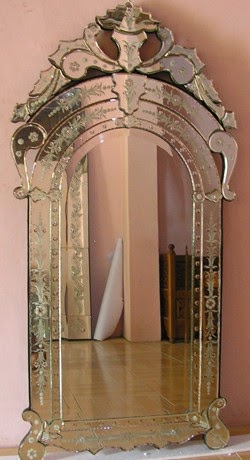
venetian __ In ancient times, people used obsidian stones to make mirrors. These stones when highly polished were able to reflect with a great clarity. Through times, as civilization evolved, technology did too. Gradually, people started to use gold, silver, and aluminum to create mirrors in the similar manner they used the obsidian stone. In about 1600 AD, the silvering process, which became the most popular way to make mirrors, was introduced and it is used even today.

In classical antiquity, solid metal (bronze, later silver) was used to manufacture mirrors and mirrors were too expensive; they were also prone to corrosion.

Venetian glassmakers introduced the process of making mirrors out of plate in 16th century. They covered the back of the glass with mercury to obtain near-perfect and undistorted reflection.

Today, the mirror substrate is first shaped, then polished and cleaned, and finally covered.

The method of making mirrors is very simple. Mirrors are made by applying a reflective coating to a glass sheets. Glass is a major mirror component due to its transparency, ease to fabrication, rigidity, hardness, and ability to take a smooth finish but it is not very good material for reflection. Materials which are commonly used are metal coatings such as silver, gold or chrome. Present-day glass mirrors are most often coated with non-toxic silver or aluminum.

It is very important that the glass is polished to perfection, any dip or impurity left on glass would made waves in the mirror, which would cause distortion of the image reflected.

There are many methods of glass to be coated with the chosen metal to form a mirror. In industrial productions, glass is coated by bringing the metal to a boil in special chambers and then metal is condensed on the glass sheet to form a thin but perfect coating of the metal. The back surface of the mirror is painted to prevent damage to the metal coating.

Mirrors have to be specially designed in order to become effective, and the glass sheets that are used must be flat and durable. For household use, the thickness of the mirror is very important, with its strength increasing proportionately to its thickness. For heavy-duty mirrors and mirrors used in scientific research, the surface needs to be designed in particular way to retain uniformity while adding a curvature. This process gives the mirror the ability to focus as well as reflect light. The kind of coating to be used is specified by the mirror design. Durability and reflectivity are the most important characteristics in the choice of the coating.
An important part of the manufacturing process is the quality control of mirrors. Inspection of the mirror's surface is generally performed using the naked eye or a microscope in order to check if there are any scratches

Çontact Us
Address : Jln. Bonang 3 RT 2 RW 2, Joyotakan, Serengan, Surakarta, Jawa Tengah, Indonesia, Indonesia 57157Owner : Prima Warsa BaruPhone :  +62 888 6 827 827Email : sales@jagomerahcraft.comFanpage Facebook : jagomerahcraft
antique mirror


antique mirror, beautiful mirror, special mirror

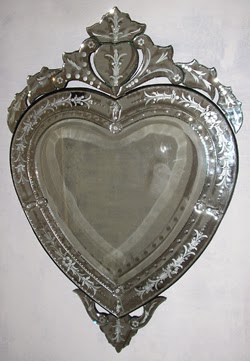
antique mirror __ The first mirrors used by people were most likely pools of dark, still water, or water collected in a primitive vessel of some sort. The earliest manufactured mirrors were pieces of polished stone such as obsidian, a naturally occurring volcanic glass. Examples of obsidian mirrors found in Anatolia (modern-day Turkey) have been dated to around 6000 BC. Polished stone mirrors from Central and South America date from around 2000 BC onwards Mirrors of polished copper were crafted in Mesopotamia from 4000 BC, and in ancient Egypt from around 3000 BC. In China, bronze mirrors were manufactured from around 2000 BC, some of the earliest bronze and copper examples being produced by the Qijia culture. Mirrors made of other metal mixtures (alloys) such as copper and tin speculum metal may have also been produced in China and India. Mirrors of speculum metal or any precious metal were hard to produce and were only owned by the wealthy.

Metal-coated glass mirrors are said to have been invented in Sidon (modern-day Lebanon) in the first century AD, and glass mirrors backed with gold leaf are mentioned by the Roman author Pliny in his Natural History, written in about 77 AD. The Romans also developed a technique for creating crude mirrors by coating blown glass with molten lead.

Parabolic mirrors were described and studied in classical antiquity by the mathematician Diocles in his work On Burning Mirrors. Ptolemyconducted a number of experiments with curved polished iron mirrors, and discussed plane, convex spherical, and concave spherical mirrors in his Optics. Parabolic mirrors were also described by the physicist Ibn Sahl in the 10th century, and Ibn al-Haythamdiscussed concave and convex mirrors in both cylindrical and spherical geometries, carried out a number of experiments with mirrors, and solved the problem of finding the point on a convex mirror at which a ray coming from one point is reflected to another point. By the 11th century, clear glass mirrors were being produced in Moorish Spain.

In China, people began making mirrors with the use of silver-mercury amalgams as early as 500 AD.Some time during the earlyRenaissance, European manufacturers perfected a superior method of coating glass with a tin-mercury amalgam. The exact date and location of the discovery is unknown, but in the 16th century, Venice, a city famed for its glass-making expertise, became a centre of mirror production using this new technique. Glass mirrors from this period were extremely expensive luxuries. The Saint-Gobain factory, founded by royal initiative in France, was an important manufacturer, and Bohemian and German glass, often rather cheaper, was also important.

The invention of the silvered-glass mirror is credited to German chemist Justus von Liebig in 1835. His process involved the deposition of a thin layer of metallic silver onto glass through the chemical reduction of silver nitrate. This silvering process was adapted for mass manufacturing and led to the greater availability of affordable mirrors. Nowadays, mirrors are often produced by the wet deposition of silver (or sometimes aluminum via vacuum deposition) directly onto the glass substrate.

Çontact Us

Address : Jln. Bonang 3 RT 2 RW 2, Joyotakan, Serengan, Surakarta, Jawa Tengah, Indonesia, Indonesia 57157Owner : Prima Warsa BaruPhone :  +62 888 6 827 827Email : sales@jagomerahcraft.comFanpage Facebook : jagomerahcraft