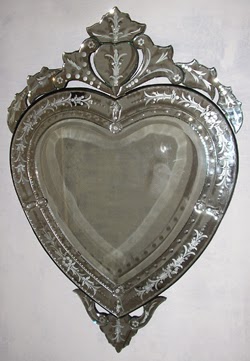
interesting news mirror __ The history of mirrors starts in the III Century B.C. Most ancient mirrors were made from metal and had a round shape. The back side of the ancient mirrors was beautifully embellished with ornamentation. Mirrors were made from highly polished bronze and silver. The first glass mirrors were invented in I Century by Romans.
From ancient times special qualities had been given to mirrors, that no other object had. The Greek philosopher Socrates gave advice to young men to look at themselves in the mirror, and those who were handsome should focus their life on keeping their souls clean and stay away from the temptations of life that could take them on the wrong path. If a young man would find that he is not handsome, he should compensate for his look from his heart, and get known for doing a lot of good things.
In Medieval period glass mirrors completely disappeared, because during those times religious confessions stated that devil is looking and watching the world from the opposite side of a glass mirrors. Poor fashionable ladies had to use a polished metal mirrors or special water bowls instead of glass mirrors.
Glass mirrors came back only in 13th century. This time they were bended slightly outward. The method of attaching tin to the flat surface of the glass wasn't invented yet. Using available technology master glaziers poured hot tin into glass tubs, and then, after the tin was cold, they would brake it into separate pieces.
Only three centuries later Venetian masters invented a "flat mirror technique". They figured out how to attach tin to a flat glass surface. Venetian masters invented another trick. They created a special reflective mixture in which gold and bronze was added. Because of this "magical" mixture all objects reflecting in the mirrors looked much more beautiful than in reality. The cost of one Venetian mirror then was comparable to the cost of the large naval ship.
In a city of Nuremberg (Germany) in 1373 the first mirror manufacturing plant was open. Mirrors were then aggressively integrated in all aspects of life. In the 16th century mirrors become a part of mysterious rituals and witchcraft. Also, for 200 years mirrors were used by Spanish and French spies for coding and decoding secret messages. This secret coding system was introduced in 15th century by Leonardo da Vinci. The scriptures were coded in "mirror reflection" and without the mirror it was impossible to read the message. Mirrors were part of another big invention of the time - the periscope. The opportunity to discreetly spy on ones enemy by using a system of interactive mirrors saved a lot of lives during wars. During the famous Thirty Year war, mirrors were used by all sides to blind the enemy during military actions with bright reflection of sun light. It was very hard to take aim when your eyes are blinded by thousands of tiny mirrors.
Starting with 12th century no respectful lady left her house without a small mirror. Handheld mirrors and pears mirrors became a must have items for every woman. Ladies wore gold embellished mirrors on a chain around their neck or waist, inserted mirrors in to the fens. Mirrors were treated just like precious jewelry, and were incased in specially crafted exotic materials like turtle shell or elephant bone frames. Some of the mirror's frames were made from gold or silver with an elegant miniature engravings.
In the 15th century the Venetian Island of Murano become the center of glass making and was known as the "Isle of Glass". They officially created the "Council of Ten" with a special mission of vigorously protecting the secrets of there glass making techniques. Masters glassmakers were secretly transported to the island of Murano undercover as a firefighters. The "Council of Ten" generously supported glassmakers and at the same time kept them isolated from the rest of the world. The profits from the mirror making monopoly were too large to take any risks. European monarchs at whatever it cost tried to find out the Venetian glassmaking secrets. They accomplish this goal in 17th century, when Colbert (the minister of Ludwig XIV) bribed with gold three Murano masters and transported them in to France.
The French happened to be a good students, and very quickly they not only mastered Murano glass making techniques, but invented they're own. While mirror making techniques used by Venetian masters was based on a glassblowing, French masters started manufacturing mirrors using casting techniques based on pouring glass into the cast molds. The glass was poured directly from the dome into perfectly smooth surface of the cast mold, and then, as the glass was cooling, it was rolled with the special rollers achieving a perfect consistency and smoothness of material. Immediately after this invention, in Versailles the construction of the Mirrors Gallery began. The Mirrors Gallery was 220 feet (73 meters) long and embellished with 306 huge mirrors.
On the end of 16th century, following the high fusion style, French queen Maria De Medici decided to create for herself a Mirrored office. For this matter, 119 mirrors was purchased from Venice. Maybe because her purchase was so large, or for some other reason, Venetian masters created a special gift for the queen of France - a unique large mirror generously incrusted with precious stones. Till this day this mirror is preserved and kept in the Louvre in Paris.
Mirrors become a popular valuable collectibles among royals. English King Hendry VIII and the King of France Francis I were the most known mirrors collectors of there time. Trying to catch up with kings, nobles in France had to have an extravagant mirrors in any cost. There is a knowing facts that some of them had to sell one of they residents in order to purchase a single beautiful mirror. Mirrors were extremely costly. For example one mirror cost more than an Rafael's painting of the same size.
In 17th century Russia, mirrors were considered a sin. In 1666 the Orthodox Church in prohibited the possession of mirrors by its priests. From this time on a lot of superstitions surrounded mirrors. Those superstitions seems to us funny and naive, but back than people took it very seriously. Breaking a mirror, for example, was sign of bad lack for seven years. That is why when a mirror was broken the person who broke it should apologies to the mirror for clumsiness, and had to carefully and respectfully bury it. Solders took mirrors-talismans to reflect away death.
Mirrors have had a long and colorful journey throughout history. In our days there is no home without a mirror. Mirrors have become part of our everyday routine, often unappreciated. We always should remember "reflect" and respect the historical aspects of mirrors and appreciate more not only mirror's functionality, but incredible esthetical value of the mirrors
Çontact Us
Address : Jln. Bonang 3 RT 2 RW 2, Joyotakan, Serengan, Surakarta, Jawa Tengah, Indonesia, Indonesia 57157Owner : Prima Warsa BaruPhone : +62 888 6 827 827Email : sales@jagomerahcraft.comFanpage Facebook : jagomerahcraft